


Why do runners need strength training? It doesn't matter whether you're training for a 5k, jogging a loop of the park with friends or sprinting for gold – there's more to running than speed, heart rate and intervals.
Targeted strength work can improve your power, speed and endurance, refine your running form and reduce your injury risk, so you stay in the race.
That's why Centr developed the 6-week Strength For Runners training programme, to help you run stronger and keep going for longer.
The benefits of strength training for runners
As a runner, the aim of strength training isn't to build muscle mass – it's to develop a strong, durable body that can handle long distances.
The benefits of a programme like Centr's Strength For Runners include:
- Injury prevention: stronger muscles help you hold good running form even as you tire, which reduces the risk of common injuries. Better stability also supports the tendons and ligaments that protect key joints.
- Better running economy: running economy refers to how much oxygen your body uses at a given speed or distance, and how efficiently you use it. Strength training helps your muscles use that oxygen better, so you expend less energy with every stride.
- Higher VO2 max: a key factor in running economy and aerobic performance. VO2 max measures how much oxygen your body can take in and use during exercise. High-intensity strength work (plyometrics, for instance), interval training and endurance training can all help raise it.
- Better running form: a stronger core increases the stability of your torso, improves your balance and gets your hips, back and legs working together more smoothly.
- More speed: think of how an Olympic sprinter explodes out of the blocks – that takes power and explosiveness from your calves and glutes right through to your biceps.
- Better muscular endurance: strength training improves your muscles' ability to sustain prolonged effort, so you can run further and for longer. That's crucial for long-distance runners.

The key muscles for runners to train
Leg day is all that counts for runners, surely? Not quite – your whole body has to work as a single connected unit to perform at its best.
These are the muscles to train regularly:
- Lower body: focus on the quadriceps, hamstrings, glutes and calves for explosive power, propulsion and stability.
- Core: strong core muscles are crucial to maintaining your running posture, keeping your body stable and reducing fatigue.
- Upper body: often overlooked by runners, but back and arm strength contribute to an efficient stride and forward drive. Don't neglect your chest or shoulders either.
Essential strength exercises for runners
Any form of strength training benefits your running. But our experts chose every exercise in the Strength For Runners programme carefully, because specific movements improve specific aspects of performance.
Take the soleus, for example. Part of your calf, it carries most of the load while running, and the best way to train it is with bent-knee or seated calf raises.
These are the types of exercise to focus on:
- Single-leg exercises: movements such as single-leg Romanian deadlifts or alternating reverse lunges can address muscular imbalances and improve your balance.
- Bodyweight core exercises: planks, flutter kicks and Russian twists target your core for more stability and control.
- Weighted exercises: dumbbell movements such as suitcase squats and presses build not just strength but muscular endurance.
- Mobility work and stretching: mobility exercises such as VMO dips, downward dog and shoulder circles help reduce muscle tightness, maximise flexibility and prevent injury.
How to structure a strength programme for runners
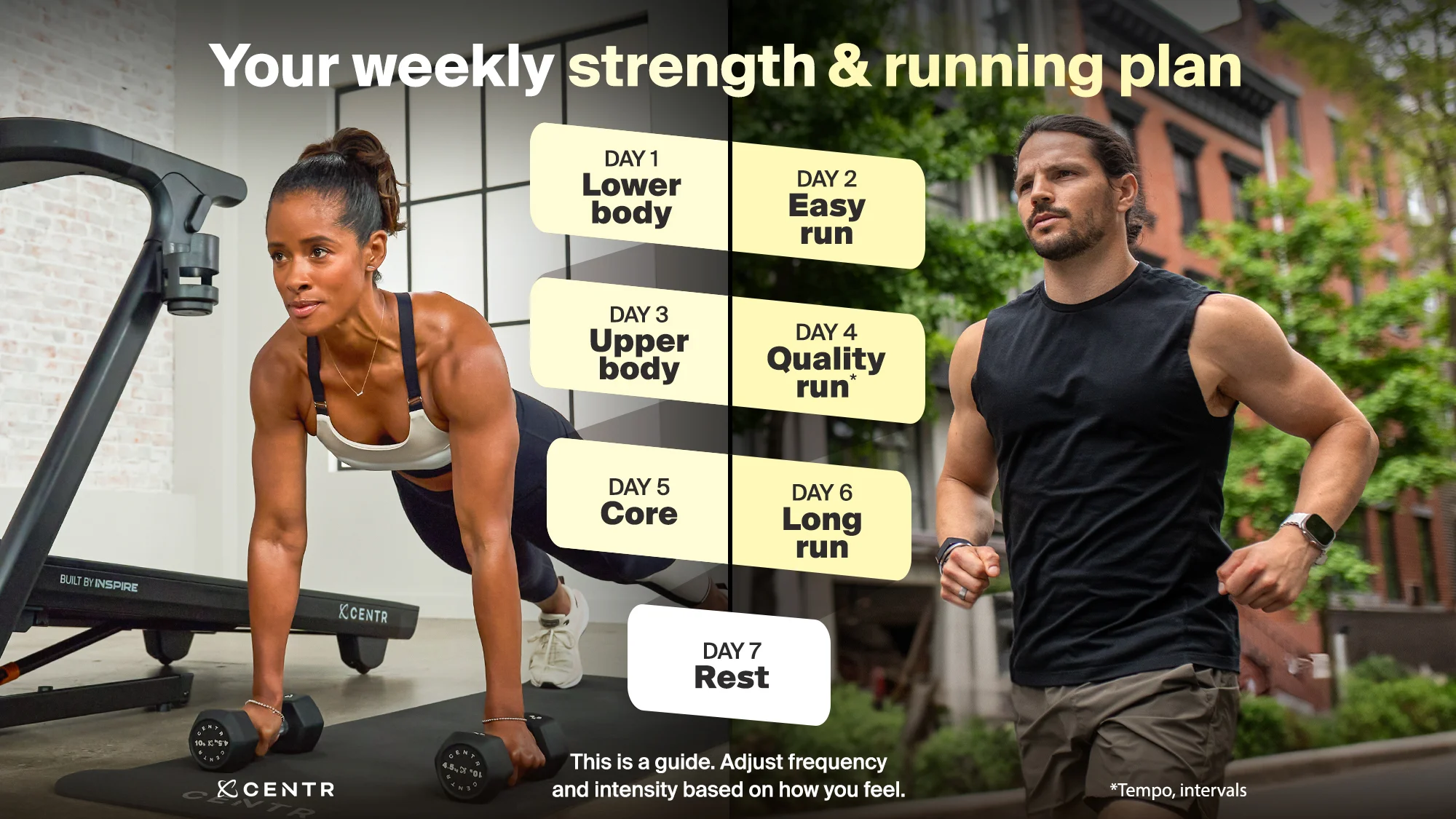
To put together a strength programme that supports your running, we'd recommend the following:
- Train 3 times a week, alternating strength sessions with your running days.
- Always warm up with dynamic movements that prepare you for strength work and running alike.
- Keep your strength sessions efficient – 30 to 40 minutes is plenty.
- Do 3 sets per exercise of 8 to 15 reps.
- Use moderate to heavy weights for compound movements and lighter weights for higher reps.
- Follow the principle of progressive overload: increase the weight as you get stronger.
Depending on your running goals – a marathon, for instance – you can adjust how often you do strength work.
Want more guidance? Take a look at our Strength For Runners programme here.
Avoiding common strength training mistakes
Runners, take note. Keep the miles coming by avoiding these common mistakes:
- Overtraining: don't try to cram all your running and strength work into a single day. Alternate them, as the programme recommends.
- Neglecting the upper body: an unbalanced body is more prone to injury. Strong shoulders, biceps and lats all contribute to better performance.
- Poor technique: take the time to perform your strength work correctly, so you avoid injury and get the most from every session.
This article was originally published on Centr.com


