


A tight, well-defined six-pack is the ultimate fitness goal for plenty of people. Visible abdominal muscles depend largely on a low body fat percentage, but specific ab exercises play a crucial role in strengthening and shaping the muscle group. In this article we cover the best exercises for training your six-pack, including movements using weights and other equipment. We also look at the anatomy of the abdominal muscles and how many exercises you need to train them effectively.
The abdominal muscles
The abdominal muscles, or core, are an important muscle group in the human body, made up of four main muscles: the rectus abdominis, the transversus abdominis, and the internal and external obliques. The rectus abdominis is probably the best known, often referred to as the six-pack. It runs vertically down the front of the abdomen and is responsible for flexing the spine – when you perform a sit-up, it's mainly this muscle you're working. Strengthening this group matters not just for aesthetic reasons but for the overall stability and function of your body. A strong core helps improve your posture, reduce back pain and raise your performance in a wide range of physical activities.
How many exercises do you need for stronger abs?
To strengthen your abdominal muscles effectively, we'd recommend at least three to four different exercises per session. Variety is essential for working every part of the abdominals and stopping your muscles getting used to the same routine. Try to include an ab session 2-3 times a week, performing each exercise for 3 sets of 10-15 reps. Performing the exercises correctly and focusing on proper muscle activation both matter for getting the best results.

Exercise 1: Plank
The plank is an excellent exercise for strengthening the whole core, including the rectus abdominis, transversus abdominis and obliques. Start in a press-up position with your forearms on the floor and your body in a straight line from head to heels. Hold that position for as long as you can, keeping your abdominal muscles engaged and your back straight.
Once you're comfortable, you can make the plank more demanding by adding variations such as lifting one leg or arm, or planking on an unstable surface such as an exercise ball. These variations help activate the stabilising muscles in the core further. If you don't have a flat surface to work on, it's worth picking up an exercise mat.

Exercise 2: Crunches
Crunches are a classic exercise targeting the rectus abdominis specifically. Lie on your back with your knees bent and your feet flat on the floor. Place your hands behind your head without pulling on your neck. Lift your shoulder blades off the floor by engaging your abdominal muscles, then lower yourself again without letting your head rest fully on the floor.
To make crunches more effective, try variations such as the bicycle crunch, where you make a cycling motion with your legs while bringing your elbow towards the opposite knee. These variations put extra load on the obliques and strengthen the core further.
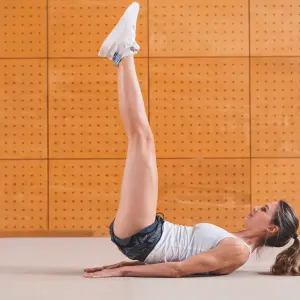
Exercise 3: Leg raises
Leg raises are particularly effective for training the lower abdominal muscles. Lie on your back with your hands at your sides or under your glutes for extra support. Keep your legs straight and lift them slowly until they're perpendicular to the floor. Lower them under control without letting your feet touch the ground.
For an extra challenge, combine leg raises with a hip lift, raising your hips off the floor once your legs are in the air. That increases the intensity and activates the lower abdominals further still.
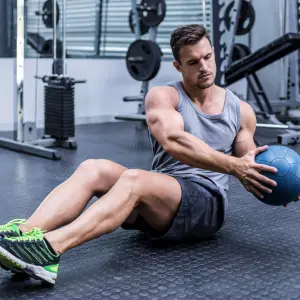
Exercise 4. Russian twists
Russian twists are ideal for training the obliques. Sit on the floor with your knees bent and your heels slightly off the ground. Hold a weight or a medicine ball in both hands. Lean back slightly and rotate your torso left and right, moving the weight beside your hips.
You can raise the intensity by keeping your feet off the floor, which demands extra balance and stabilisation from the core. Try rotating more slowly too, to keep more tension on the muscles.

Exercise 5: Ab wheel rollouts
An ab wheel is an effective training tool for strengthening the rectus abdominis and the deeper abdominal muscles. Start on your knees with the ab wheel in front of you. Roll slowly forward until your body is almost parallel to the floor, then roll back to the starting position by engaging your abdominal muscles.
This exercise demands good technique and control to avoid injury. Start with short distances and build up gradually as your strength increases. It's a challenging movement that requires a great deal of stability and strength.
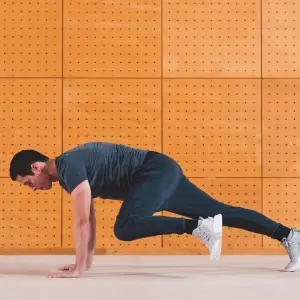
Exercise 6: Mountain climbers
Mountain climbers are a dynamic exercise that trains the core and the cardiovascular system alike. Start in a press-up position and bring your knees alternately towards your chest in a quick, running motion. Keep your abdominal muscles engaged and your back straight throughout.
This exercise raises your heart rate while training your core, which makes it an excellent choice for a full-body workout. Try varying the speed or adding lateral mountain climbers for extra variety and intensity.
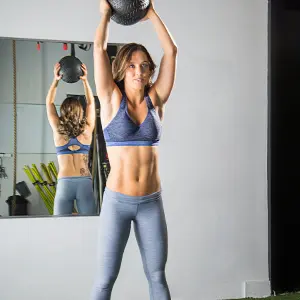
Exercise 7: Medicine ball slams
Medicine ball slams are a power-focused exercise that trains the whole core. Stand upright with a medicine ball overhead. Slam it into the floor with full force while engaging your abdominal muscles. Catch it on the bounce and repeat.
This exercise combines strength with explosive power, which helps build functional core strength. It's also a great way to relieve stress and burn off energy during your session.
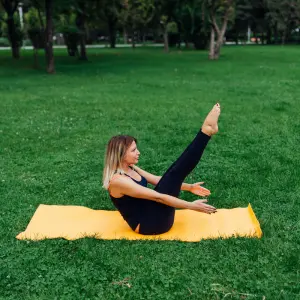
Exercise 8: V-ups
The V-up is an advanced exercise that trains the upper and lower abdominal muscles together. Lie flat on your back with your arms extended overhead and your legs straight. Lift your arms and legs at the same time so your body forms a V shape. Touch your toes with your hands, then lower yourself back to the starting position under control.
This exercise demands good coordination and balance, which makes it a challenging addition to your ab training. Make sure you perform the movement slowly and under control to keep maximum tension on the muscles.
Building a visible six-pack with these exercises
In short, an impressive six-pack takes commitment, variety and a combination of targeted exercises. By training consistently and working the upper and lower abdominals along with the obliques, you can develop a strong, well-defined core. Don't forget that nutrition and your overall body fat percentage are crucial factors in making your abdominal muscles visible. Combine these exercises with a balanced diet and a complete fitness programme for the best results.


