


Building muscular, well-shaped biceps is a common goal for fitness enthusiasts worldwide. The biceps, at the front of the upper arm, are one of the most visible and iconic muscle groups in the human body. Strong biceps matter not just for how you look – they play a part in everyday tasks and in improving the overall strength and capability of your upper arms. In this article we cover some of the best exercises for training the biceps effectively, from classic biceps curls through to more advanced movements using weights and machines.
The biceps
The biceps brachii, or simply the biceps, is a two-headed muscle at the front of the upper arm. As the name suggests, it consists of two heads: the long head and the short head. Both originate at the scapula (shoulder blade) and attach to the radius in the forearm. The biceps' main function is bending the elbow, but it also plays a role in supinating (rotating) the forearm. Strong biceps aren't just an aesthetic matter – they're involved in lifting, gripping and pulling objects in everyday life.
How many exercises do you need for strong biceps?
To develop stronger, better-built biceps, we'd recommend including at least 5 to 10 different exercises in your routine. Performing a variety of movements lets you target different parts of the biceps effectively and stimulate overall muscle growth. Adding variety to your programme also helps prevent boredom and break through plateaus in your progress. It's worth remembering, though, that quality of execution matters more than quantity. Focus on using correct technique, controlling the movement, and performing each exercise slowly and deliberately for maximum muscle activation and growth.
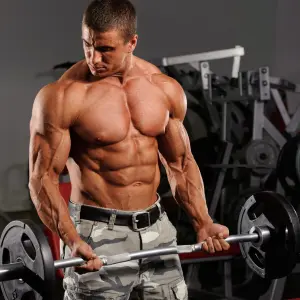
Biceps exercise 1: Barbell biceps curls
Barbell biceps curls are a classic, effective exercise for isolating and strengthening the biceps. Start by standing upright with a barbell in your hands, palms facing forward and elbows close to your body. Bend your elbows slowly and lift the barbell up towards your shoulders, squeezing your biceps. Hold the top position briefly, then lower the barbell under control to the starting position.
Barbell biceps curls can be performed with different grips, wide or narrow, to target different parts of the biceps. Make sure your elbows stay still throughout the movement and keep the execution slow and controlled for maximum muscle activation. Using an EZ curl bar takes the pressure off your wrists. If you feel pain performing a standard barbell biceps curl, the EZ curl bar version is a good alternative.

Biceps exercise 2: Dumbbell hammer curls
Dumbbell hammer curls are an excellent exercise for training not just the biceps but the brachialis, which sits beneath them. Start by standing upright with a dumbbell in each hand, palms facing inwards. Bend your elbows slowly and lift the dumbbells up towards your shoulders, squeezing your biceps. Hold the top position briefly, then lower the dumbbells under control to the starting position.
Dumbbell hammer curls can be performed with different grips and resistance levels to vary the intensity. Focus on a slow, controlled movement to isolate the muscles effectively and maximise activation.

Biceps exercise 3: Preacher curls
Preacher curls are an excellent exercise for isolating and strengthening the biceps completely. Sit at a preacher curl bench and rest your upper arms on the angled pad so your elbows hang free. Take a barbell or dumbbells with your palms facing up and your arms fully extended. Bend your elbows slowly and lift the weight up towards your shoulders, squeezing your biceps. Hold the top position briefly, then lower the weight under control to the starting position.
Preacher curls isolate the biceps and reduce the chance of other muscles compensating. Adjust the weight to suit your strength and focus on slow, controlled execution for maximum muscle growth and strength development.

Biceps exercise 4: Concentration curls
Concentration curls are a great exercise for isolating the biceps and using the full range of movement. Sit on a bench and take a dumbbell in your right hand. Place your elbow against the inside of your right thigh and let your arm hang fully extended. Bend your elbow slowly and lift the dumbbell up towards your shoulder, squeezing your biceps. Hold the top position briefly, then lower the dumbbell under control to the starting position.
Concentration curls work through the biceps' full range of movement and can help develop symmetrical muscle on both sides of the upper arm. Focus on slow, controlled execution to isolate the muscles effectively and maximise activation.

Biceps exercise 5: Incline dumbbell curls
Incline dumbbell curls are an effective exercise for isolating the biceps and maximising muscle fibre recruitment. Lie back on an incline bench with your back and head supported. Take a dumbbell in each hand with your palms facing up and your arms fully extended. Bend your elbows slowly and lift the dumbbells up towards your shoulders, squeezing your biceps. Hold the top position briefly, then lower the dumbbells under control to the starting position.
Incline dumbbell curls produce a greater stretch through the biceps and recruit more muscle fibres for maximum growth and development. Set the bench at an angle that feels comfortable and focus on a slow, controlled movement throughout.

Biceps exercise 6: Cable biceps curls
Cable biceps curls are a great exercise for keeping constant tension on the biceps through the full range of movement. Attach a handle to a low cable pulley machine and take it with your palm facing up. Stand upright with your elbow close to your side and your upper arm still. Bend your elbow slowly and pull the handle up towards your shoulder, squeezing your biceps. Hold the top position briefly, then lower the handle under control to the starting position.
Cable biceps curls provide even resistance through the full range of movement, which can help maximise muscle growth and strength development. Adjust the weight to suit your strength and focus on slow, controlled execution for the best results.
Training for stronger, bigger biceps
By building a variety of biceps exercises into your routine regularly, you can isolate and strengthen the muscle effectively for maximum growth and strength development. It's worth remembering that consistency, commitment and good technique are crucial to results. Listen to your body, give your muscles enough rest and recovery between sessions, and adapt your programme to your own needs and goals. With the right approach, you'll be well on the way to stronger, well-developed biceps you can be proud of.


