


Strong, well-developed shoulders are essential to a balanced, powerful upper body. They play a crucial role in countless everyday activities and in sport, from lifting and throwing to swimming and rowing. Kettlebells offer a versatile, effective way to train your shoulders, whether you train at home or at the gym. In this article we cover 7 effective kettlebell exercises you can use to strengthen and build your shoulders.
The shoulders as a muscle group
The shoulder muscles, known as the deltoids, consist of three main parts: the anterior deltoid, the lateral deltoid and the posterior deltoid. These muscles work together to control the movement and stability of the shoulder joint. The anterior deltoid lifts the arm forwards, the lateral deltoid lifts it out to the side, and the posterior deltoid lifts it backwards. Strong, well-developed shoulders are crucial to improving your overall upper-body strength, stability and function. They don't just support your arms through countless movements – they contribute to a symmetrical, balanced physique too.
The benefits of strong shoulders
Developing strong shoulders brings several benefits for your overall fitness and wellbeing. First, strong shoulders improve your overall upper-body strength and function, which can make everyday tasks such as lifting, pushing and pulling easier. Well-developed shoulders also contribute to a symmetrical, aesthetically pleasing upper body. On top of that, strong shoulders can improve your performance in sports including swimming, basketball and volleyball. Finally, they help reduce your risk of shoulder injury by improving the stability and support of the shoulder joint.
How many exercises do you need for stronger shoulders?
To train your shoulders effectively and develop them symmetrically, we'd recommend including 5 to 7 different exercises in your routine. Using a mix that targets the anterior, lateral and posterior deltoids lets you build a balanced, well-developed set of shoulders. Variety also helps prevent boredom and encourages steady progress. Start with light kettlebells and build up gradually as you get stronger and more familiar with the exercises. Focus on improving your technique and form before moving to heavier weights, to avoid injury and get the best results.
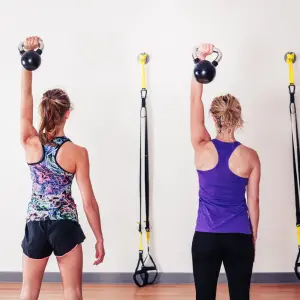
Kettlebell exercise 1: Shoulder press
The kettlebell shoulder press is a classic exercise that targets the anterior and lateral deltoids effectively. Stand with a kettlebell in each hand, holding them at shoulder height with your palms facing forward. If that proves too demanding standing, you can also perform the shoulder press seated on a training bench. Press the kettlebells up until your arms are fully extended, hold briefly, then lower them under control to the starting position. As an extra variation, you can use a resistance band looped around your forearms, keeping it stretched apart. That way you activate all three deltoid heads. This exercise strengthens the shoulder muscles and improves your overall upper-body strength and stability.

Kettlebell exercise 2: Lateral raise
The kettlebell lateral raise is an isolation exercise targeting the lateral deltoid. Stand upright with a kettlebell in each hand, arms extended at your sides and palms facing inwards. Lift the kettlebells out to the sides up to shoulder height, hold briefly, then lower them under control to the starting position. This exercise helps develop broad, well-defined shoulders.

Kettlebell exercise 3: Front raise
The kettlebell front raise targets the anterior deltoid. Start standing with a kettlebell in each hand, arms extended at your sides and palms facing inwards. Lift the kettlebells straight out in front of you to shoulder height, hold briefly, then lower them under control to the starting position. This exercise helps build strength and definition in the front of the shoulders.
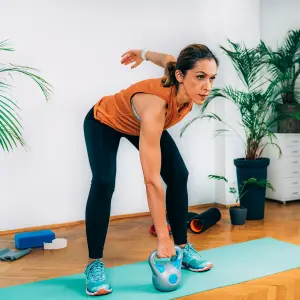
Kettlebell exercise 4: Bent-over reverse fly
The kettlebell bent-over reverse fly is an excellent exercise for isolating the posterior deltoid. Hinge forward to an angle of roughly 45 degrees with a kettlebell in each hand, arms extended downwards. Lift the kettlebells out to the sides up to shoulder height, hold briefly, then lower them under control to the starting position. This exercise contributes to balanced shoulder development and improves your posture.

Kettlebell exercise 5: Upright row
The kettlebell upright row targets the anterior deltoid and the trapezius. Stand upright with a kettlebell in each hand, arms extended at your sides and palms facing inwards. Pull the kettlebells up towards your chest, keeping your elbows high and wide. Lower them under control to the starting position. This exercise helps develop the shoulder and upper back muscles.

Kettlebell exercise 6: Shrugs
The kettlebell shrug is a simple but effective exercise for strengthening the trapezius. Stand upright with a kettlebell in each hand and your arms extended at your sides. Pull your shoulders up towards your ears, then lower them under control to the starting position. This exercise improves shoulder stability and helps develop a powerful neck and upper back.

Kettlebell exercise 7: High pull
The kettlebell high pull is a dynamic exercise that activates the shoulders, trapezius and the rest of the upper body. Start standing with a kettlebell between your legs. Drive your hips forward and pull the kettlebell up to shoulder height explosively, keeping your elbows high and wide. Lower it under control to the starting position. This exercise improves your overall upper-body strength and explosive power.
Building stronger shoulders with these kettlebell exercises
Building these kettlebell exercises into your shoulder training can produce an all-round improvement in shoulder strength, stability and muscle definition. Following a varied, balanced routine matters for targeting every part of the shoulder and avoiding injury.


